Exposing Film Stocks: 16mm Film & 35mm Film
In an age dominated by digital “fixes,” false color overlays, and the ability to change ISO with the scroll of a wheel, the true, hands-on craft of exposing celluloid has become a rare and vital skill. We see the “film look” imitated everywhere. Grain overlays, halation plugins, and LUTs designed to mimic Kodak Vision3. But how many modern filmmakers truly understand the nuts and bolts behind it all?
Film is making a comeback. From the IMAX spectacle of Oppenheimer to the gritty texture of indie darlings, directors are returning to the medium. But shooting on film is a discipline. It demands that you stop relying on a monitor and start trusting your eye, your tools, and your knowledge.
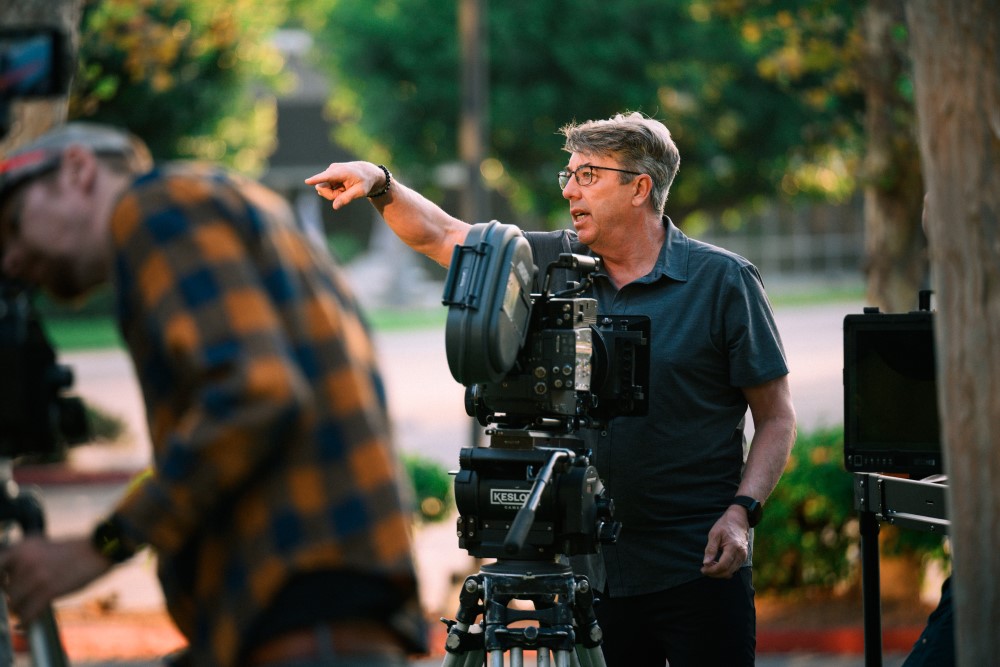
That is why I partnered with KODAK to create the Exposing Motion Picture Film Masterclass. Drawing from my experience lensing over 23 feature films on 35mm, 16mm, and Super 8 since 1986, this course demystifies the process of exposing film.
Below is an in-depth look at the foundational principles covered in the first chapter of the masterclass. We are going to strip away the digital safety net and look at the science of film stocks, the difference between negative and reversal, and the glass filters required to paint with light.

WHAT YOU WILL LEARN IN THIS ARTICLE |
|
PART 1: UNDERSTANDING YOUR CANVAS (FILM STOCKS)
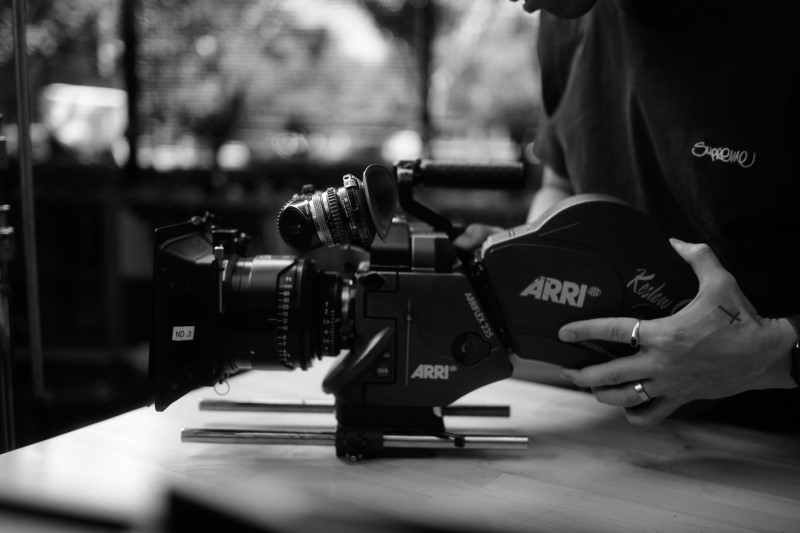
Before you can expose a single frame, you must understand the physical medium you are loading into the camera. Unlike a digital sensor, which has a fixed native sensitivity, film allows you to change your “sensor” every time you change a roll.
-
DECODING THE NUMBERS: 35MM VS. 16MM
Kodak organizes their film stocks using a specific numbering system. Understanding this code is the first step in professional film logistics.
| THE PREFIX | |
| 52 | Indicates 35mm film (e.g., 5203, 5219) |
| 72 | Indicates 16mm film (e.g., 7203, 7219) |
| THE SUFFIX | The last two digits indicate the specific emulsion type (ISO and Color Balance). |
-
COLOR NEGATIVE FILM: THE INDUSTRY STANDARD
The vast majority of modern motion pictures are shot on Color Negative film. This film produces an image with inverted colors and tones. When printed or scanned, these colors are reversed to create the final positive image. Color negative is processed using the ECN-2 chemical process.
| WHY USE NEGATIVE? |
| It offers superior dynamic range (latitude). It is forgiving in the highlights and can dig into the shadows, giving the cinematographer immense flexibility in the color grading suite (or timing lab). |
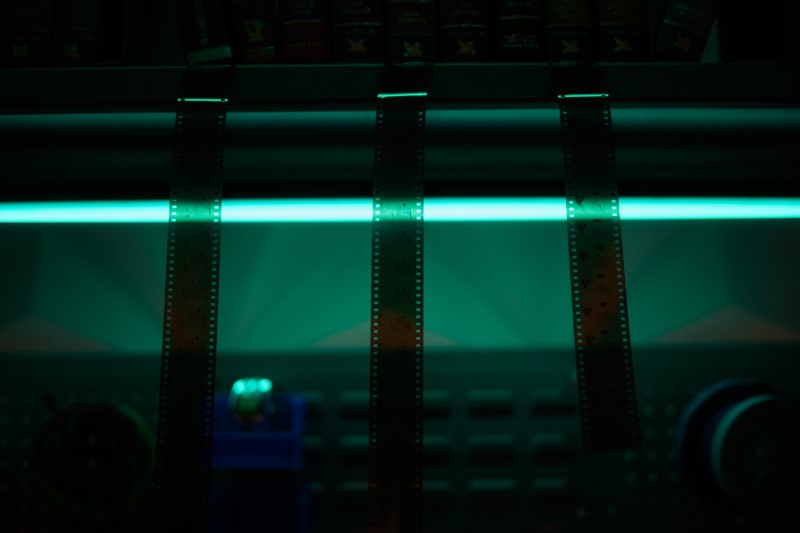
| CURRENT KODAK VISION3 STOCKS | |
| 50D (5203 / 7203) | A Daylight balanced (5600K) stock with an ISO of 50. It has the finest grain structure, perfect for bright exteriors. |
| 250D (5207 / 7207) | A faster Daylight balanced stock. |
| 200T (5213 / 7213) | A tungsten-balanced (3200K) stock. The “T” stands for Tungsten. |
| 500T (5219 / 7219) | The high-speed workhorse. Tungsten balanced, ideal for low light and night scenes. |
-
COLOR REVERSAL FILM (VNF): THE “NEWS” AESTHETIC
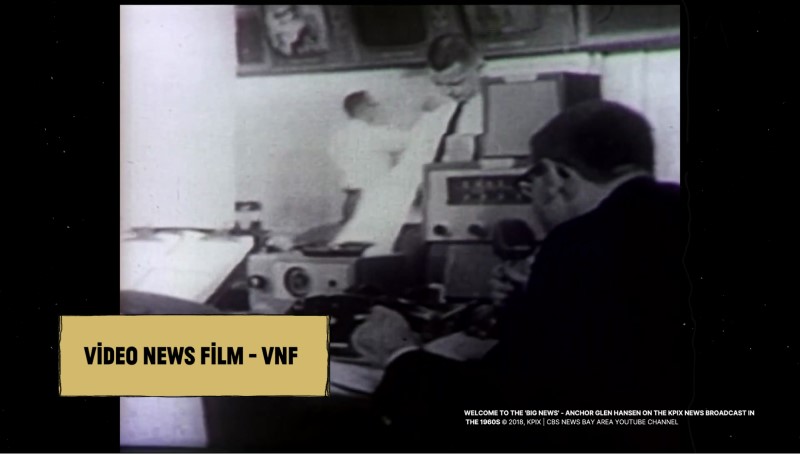
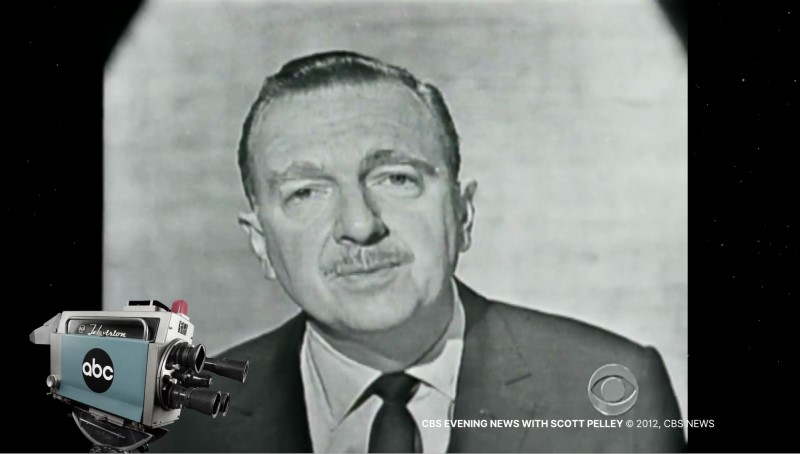
Before video cameras took over, news broadcasters used Reversal Film, often called Video News Film (VNF). Unlike negative film, reversal film produces a positive image directly on the strip — like a slide projector image.
 |
 |
The Aesthetic Trade-off: Reversal film has significantly less dynamic range (latitude) than negative film. If you miss your exposure, the film is unforgiving. However, this limitation creates a unique, “cranked” aesthetic.
| NATURAL, PUNCHY COLORS | The colors are often super-saturated and vibrant. |
| UNIQUE BLOWOUTS | When overexposed, reversal film doesn’t roll off gently like negative; it blows out in a distinct, harsh, yet artistic way. |
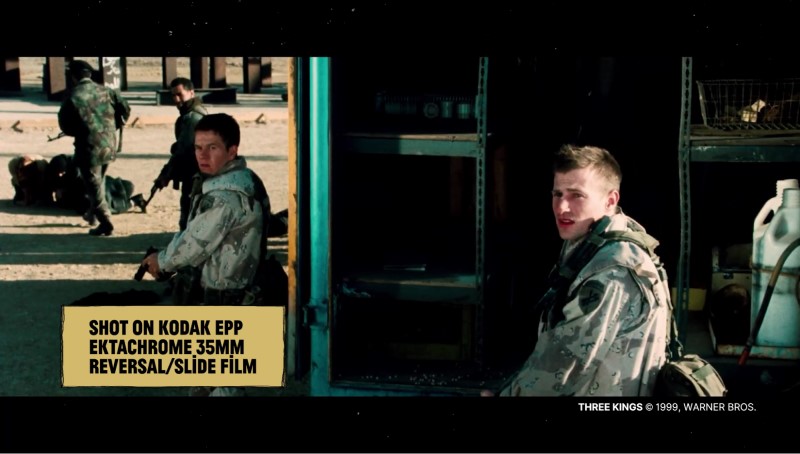
| CINEMATIC EXAMPLE |
| David O. Russell’s Three Kings (1999) famously utilized color reversal stock (specifically Ektachrome) to achieve its bleach-bypass-style, high-contrast look. The result was deep, unnatural blue skies and stark, golden-white sands that heightened the surreal nature of the narrative. |
PART 2: ANALOG WHITE BALANCE (THE ART OF GLASS)
On a digital camera, if you walk from a tungsten-lit room (3200K) out into the sun (5600K), you simply dial a knob to change your white balance. In analog filmmaking, your white balance is chemically baked into the film stock. To change it, you must be a craftsman.
THE PROBLEM: SHOOTING TUNGSTEN FILM IN DAYLIGHT
If you load a roll of 500T (Tungsten) because you love the grain structure or need the speed, but you shoot outside in daylight without modification, your image will be overwhelmingly blue. The film expects orange light, but you are feeding it blue daylight.
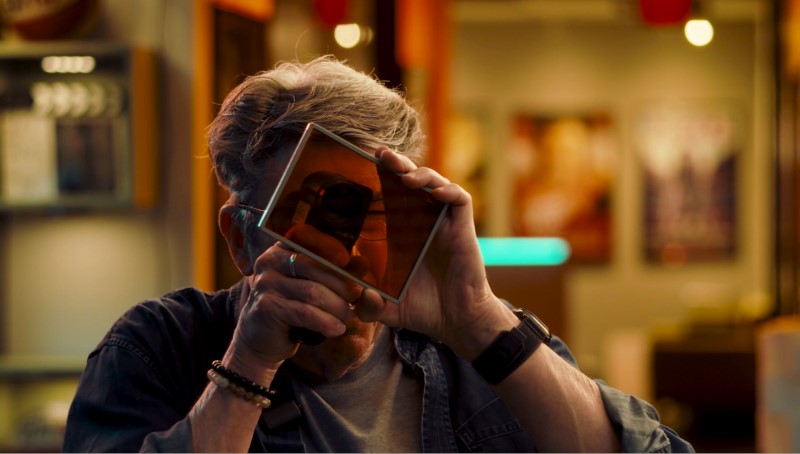
THE SOLUTION: THE 85 FILTER
To correct this “in-camera,” you must place an 85 Filter in front of the lens.
| WHAT IT IS | An orange-colored glass filter. |
| WHAT IT DOES | It physically converts the 5600K daylight entering the lens into 3200K light before it hits the film emulsion. |
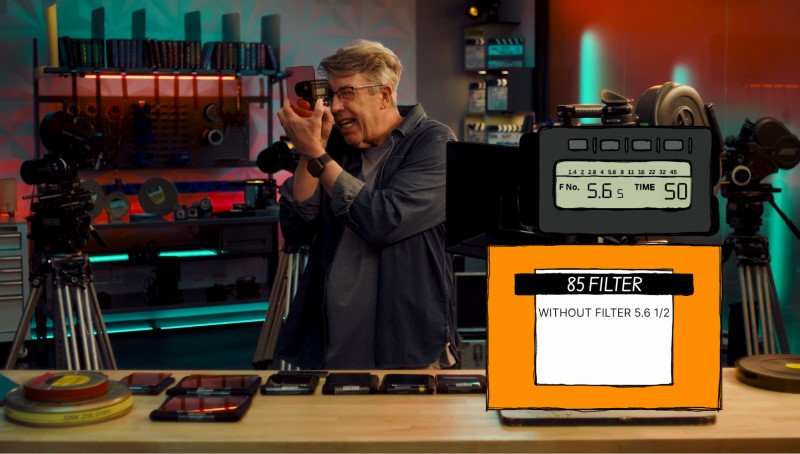
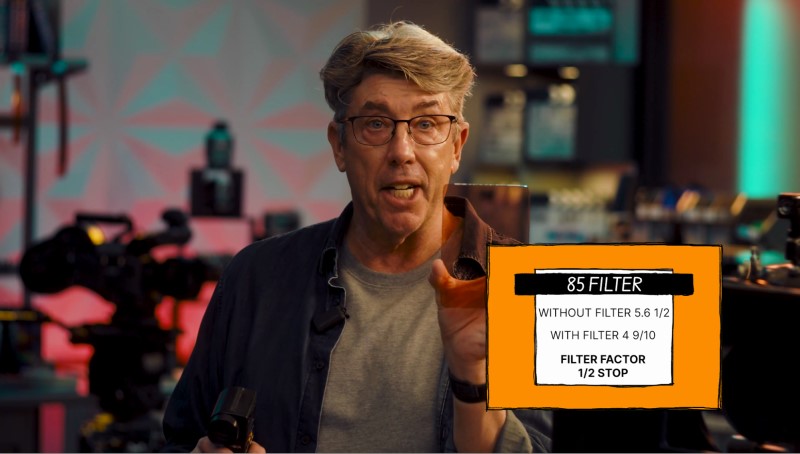
| THE COST | Placing glass in front of the lens cuts light. You must account for this Filter Factor when calculating your exposure (typically a loss of 2/3 of a stop for an 85 filter). |
 |
 |
This is the essence of analog filmmaking: solving problems with physics and glass, not software.
STOP CHASING THE “LOOK.” MASTER THE SOURCE.
What we’ve covered here—identifying stocks, understanding ECN-2 vs. Reversal, and filtration — is just the first six minutes of a deep, comprehensive education.
Shooting on film requires you to be both a scientist and an artist. You cannot rely on a waveform monitor or a false-color overlay to save you. You must understand lighting ratios, you must know how to use an incident meter and a spot meter, and you must understand how to manipulate the chemical process (Push and Pull processing) to achieve your vision.
READY TO MASTER THE CRAFT THAT ENDURES?
In the full Exposing Motion Picture Film Masterclass, I take you on location to master high-contrast backlit scenes, harsh side lighting, and the precise techniques for extending “magic hour.” We dive deep into filter factors, the philosophy of the “thick negative,” and how to control contrast using graduated NDs and attenuators.
| YOU CAN ACCESS THE FULL MASTERCLASS IN TWO WAYS | |
| BECOME A PREMIUM ANNUAL MEMBER | Get unlimited access to this masterclass, plus our entire library of hundreds of courses, monthly live coaching, and an exclusive community of filmmakers. |
| A LA CARTE PURCHASE | Buy the standalone masterclass for a one-time fee of $129.99 and own it forever. |
Forget “fast.” Choose timeless. Master the process.
This masterclass was produced in collaboration with Kodak.