A Gaffer’s Guide: Balancing Generator Load Tester
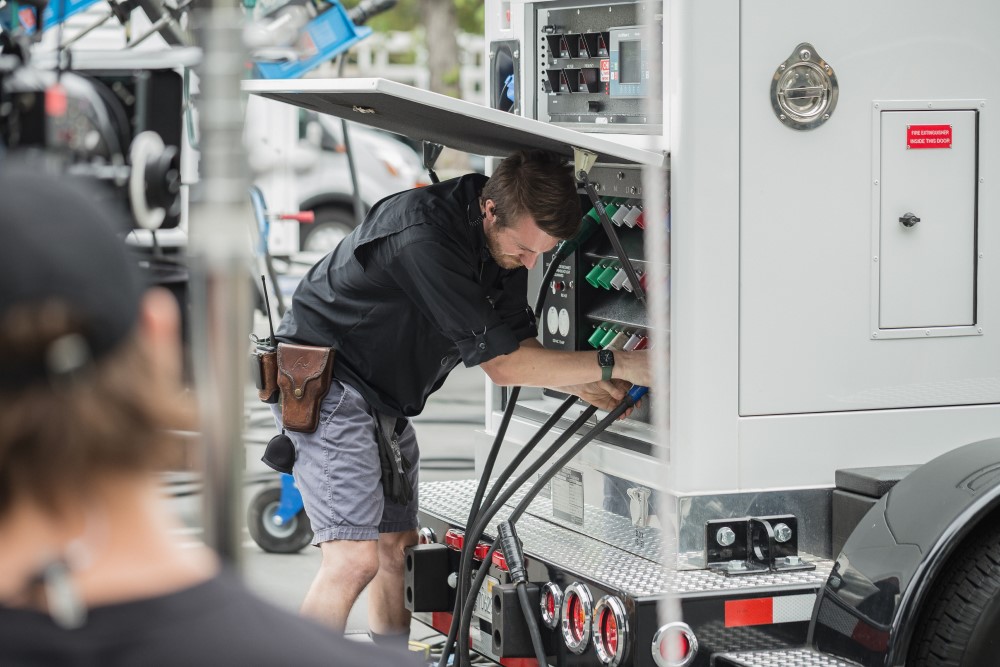
On a film set, the generator is the beating heart of the production, providing the essential power that brings every light to life. But simply plugging in lights isn’t enough. A professional gaffer’s most critical and often unseen task is balancing the generator’s load—a crucial process that ensures safety, efficiency, and the stable operation of your entire lighting package. An imbalanced generator can lead to power fluctuations, equipment damage, or even a complete shutdown in the middle of a take.
In this excerpt from our Generator Etiquette Masterclass, cinematographer Shane Hurlbut, ASC, and gaffer Thomas Sigurdsson demonstrate this essential skill. They walk through a real-world scenario, demonstrating step-by-step how to read a generator, balance large lights, and adapt to creative changes on the fly. This article provides a detailed written breakdown of their process, perfect for filmmakers who want to understand the art and science of on-set power management.
(This article is an excerpt from a lesson in our Generator Etiquette Masterclass. Included with the masterclass is a downloadable textbook lesson and checklists for diesel and battery generator safety and etiquette.)

HOW TO BALANCE YOUR GENERATOR:
THE SETUP: PREPARING FOR POWER
Before a single light is struck, Shane emphasizes a vital organizational tip: label everything.

Generator Etiquette Masterclass
The “A” HMI head, the “A” head cable, and the “A” ballast should all be clearly labeled. This simple step is invaluable for troubleshooting. If a light fails to strike, the crew can quickly isolate and swap out components—the cable, the head, or the ballast—to identify the problem, saving precious time.
STRIKING THE LIGHTS: THE INITIAL IMBALANCE
With the gear prepped, the team begins to strike the lights: two 18K HMIs and one 20K tungsten fixture. Gaffer Tom Sigurdsson immediately directs attention to the generator’s amperage meter. A film set generator typically supplies three-phase power, distributed across three separate “legs” identified by color: red, black, and blue. The goal is to have each leg draw a roughly equal amount of amperage.

Generator Etiquette Masterclass
After striking the first two 18K HMIs, Tom points out the immediate imbalance. The lights are plugged into circuits that draw from different legs, so the meter shows that some legs are working much harder than others. He also explains a key characteristic of HMI lights:
“As an HMI comes up to temp, it strikes hotter, burns more amperage, and then it idles down.”
| PRO TIP: When balancing, you must account for the initial power surge. |
THE ART OF THE BALANCE: USING A DIMMER FOR PRECISION
With the HMIs warmed up and the 20K tungsten added, the load is still uneven. To fix this, Tom employs a crucial technique. The 20K tungsten light is wired to a dimmer, giving him precise control over its power consumption.

Generator Etiquette Masterclass
He instructs the team to “dim up our 20K that we have on a dimmer… slowly, please.” By gradually increasing the power to the 20K, he can carefully add amperage to the legs it’s connected to. Keep in mind, he watches the generator’s meter the entire time.
The goal is to bring the numbers on the red, black, and blue legs as close to each other as possible. After a few precise adjustments, they achieve a perfectly balanced state, with all three legs drawing equal power. This is the ideal, efficient, and safe state for the generator to operate in.
THE INEVITABLE CHANGE: WHEN THE DP ADDS A LIGHT
A perfectly balanced setup rarely lasts long on a dynamic film set. Shane, acting as the cinematographer, makes a new request:
“I want to add a backlight. So let’s fire up that 18K.”

Generator Etiquette Masterclass
This is a common scenario, and it immediately throws the system out of equilibrium. The new 18K HMI is plugged into the blue and red legs, causing their amperage draw to spike and leaving the black leg underutilized. The generator is now imbalanced once again.

Generator Etiquette Masterclass
THE “GHOST LOAD”: BALANCING WITH A STANDBY LIGHT
This is where a key professional technique comes into play: the “ghost load.” Tom explains that to fix the new imbalance, “you would need to add a ghost load, basically a light that would increase the amperage that we wouldn’t necessarily use on set.”

Generator Etiquette Masterclass
A ghost load is a standby light fixture kept near the generator for the sole purpose of balancing the load. Shane notes, “When I was a gaffer, I would always have like, 12-light Maxis, or nine-light Maxi Brutes on standby, just for this cause.”
The team identifies that the black leg is now the “low” leg. They plug their standby Maxi Brute into a circuit on the black leg and begin to dim it up. As they increase the power to the Maxi Brute, the amperage on the black leg rises until it matches the red and blue legs.
“Look at that,” Shane exclaims as the numbers align perfectly.
They have successfully used a ghost load to rebalance the generator in response to a creative change, ensuring the system remains stable and safe.
THE BOTTOM LINE: A GAFFER’S ESSENTIAL SKILL
This masterclass powerfully illustrates that managing power on set is a dynamic balancing act. It requires careful planning, clear communication between the cinematographer and the gaffer, and the foresight to have tools like a standby “ghost load” ready to deploy.
Understanding how to read the generator’s legs and how to use dimmers and standby fixtures to maintain an even load is a fundamental and non-negotiable skill for any professional gaffer or lighting technician. It’s a craft that ensures the entire production can run smoothly, efficiently, and, most importantly, safely.
UNLOCK THE FULL MASTERCLASS!
This has been a detailed excerpt from our Generator Etiquette Masterclass. In the full masterclass, Shane Hurlbut, ASC and Tom Sigurdsson continue to explore the intricacies of on-set power, generator safety, and professional etiquette.
You can access this full lesson and the entire course in two ways:
- Become a Filmmakers Academy Premium Member for unlimited access to this and hundreds of other in-depth courses, masterclasses, and resources.
- Or, make a one-time purchase of the “Generator Etiquette Masterclass” masterclass or the complete “On Set Series: Cinematic Light Sources” course.

JOIN FILMMAKERS ACADEMY AND SAVE $50!
Ready to take your filmmaking skills to the next level? Join the Filmmakers Academy community and gain access to exclusive content, expert mentorship, and a network of passionate filmmakers. Use code FABLOG50 to save $50 on your annual membership!
This video is proudly lit exclusively by Nanlux-Nanlite Lights and sponsored by B&H and Hollyland.