Aperture
The aperture is the adjustable opening inside a camera lens. It works just like the iris of a human eye. It can get wider or smaller. Its primary job is to control the amount of light that passes through the lens. This light then hits the camera’s sensor or film strip. The aperture is a fundamental tool in cinematography. It directly affects two of the most important parts of an image: exposure and depth of field.
How Aperture is Measured: The F-Stop
We measure the size of the aperture using a scale called f-stops (or f-numbers). This scale is a source of common confusion. The numbers are counter-intuitive.
- A low f-stop number (like f/1.8, f/2, or f/2.8) means the aperture is wide open. This lets in a lot of light.
- A high f-stop number (like f/11, f/16, or f/22) means the aperture is very small. This lets in very little light.
A cinematographer “opens up” the aperture to a lower f-stop in dark situations. They “stop down” the aperture to a higher f-stop in bright situations.
The First Job: Controlling Exposure
The aperture is one of the three pillars of the Exposure Triangle (along with ISO and Shutter Speed). Its effect on brightness is simple. A wider aperture (low f-stop) creates a brighter image. A smaller aperture (high f-stop) creates a darker image. The cinematographer must balance the aperture with the other settings. This achieves a proper, well-balanced exposure.
The Creative Job: Controlling Depth of Field
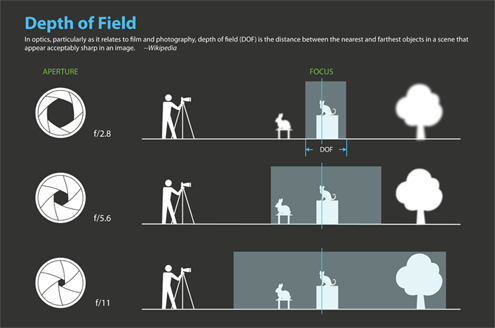
Beyond exposure, the aperture is a powerful creative tool. It is the primary way a filmmaker controls Depth of Field (DoF). Depth of field is the amount of the image that is in acceptable focus.
| Shallow Depth of Field | A wide aperture (low f-stop like f/2.0) creates a shallow depth of field. This means only a very thin plane of the image is sharp. The subject is in focus, but the foreground and background are soft and blurry. This blurry quality is known as bokeh. Filmmakers use this technique to isolate a character from their environment. It creates a “cinematic” look and directs the audience’s eye. |
| Deep Depth of Field | A small aperture (high f-stop like f/16) creates a deep depth of field. This means almost everything in the image is in sharp focus. This includes both the foreground and the distant background. A director might use a deep DoF for a wide landscape shot. They also use it in scenes where the relationship between a character and their environment is important. |
Every time a cinematographer chooses an f-stop, they are making a critical decision. They must balance the technical need for light with the artistic choice of focus. This choice directly shapes what the audience sees and feels.
« Back to Glossary Index